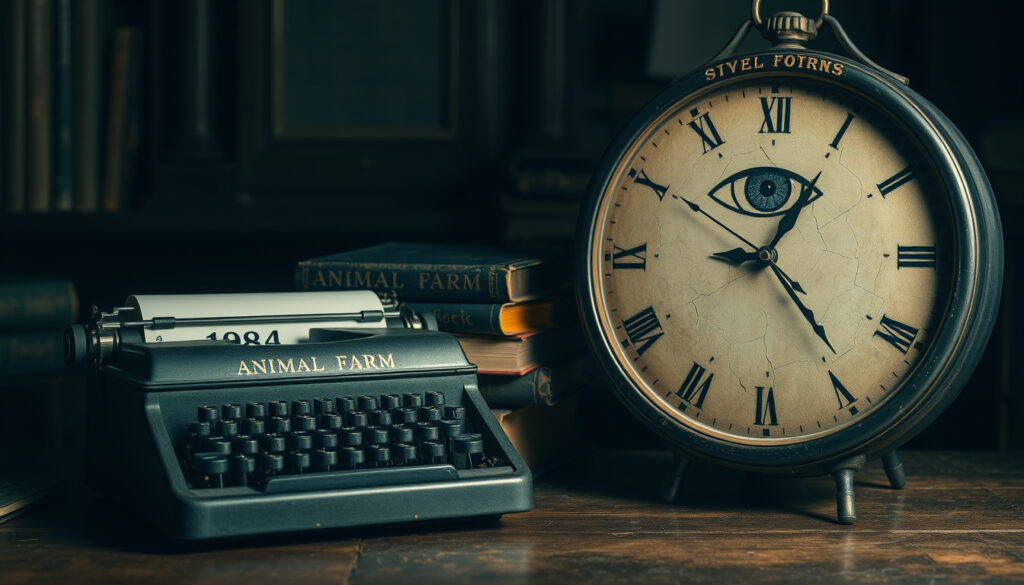
George Orwell: The Man Behind 1984 and Animal Farm
George Orwell’s name is shorthand for totalitarian surveillance and political doublethink, yet the man behind the pen name was a bundle of contradictions: a socialist who skewered the left, a defender of democracy who never shied from uncomfortable truths about his own side.
Full name: Eric Arthur Blair ·
Pen name: George Orwell ·
Born: 25 June 1903, Motihari, India ·
Died: 21 January 1950, London, England ·
Notable works: Animal Farm, Nineteen Eighty-Four ·
Occupation: Novelist, essayist, journalist
Quick snapshot
- Born Eric Arthur Blair in Motihari, India, 25 June 1903 (The Orwell Foundation)
- Died of tuberculosis in London, 21 January 1950 (The Orwell Foundation)
- Authored Animal Farm (1945) and Nineteen Eighty-Four (1949) (University of New Mexico exhibit)
- His exact emotional relationship with first wife Eileen O’Shaughnessy (Shmoop biography)
- Whether he fully reconciled his imperial past with his later socialist politics (Salem Press analysis)
- 1903: Born in India – his father served in the Opium Department (The Orwell Foundation)
- 1937: Shot in the throat during the Spanish Civil War (Salem Press)
- His works continue to be studied and debated, with 1984 often cited in discussions of digital surveillance (Wikipedia)
- The term “Orwellian” remains a political weapon on both left and right (The Orwell Foundation)
Six key facts about Orwell’s life reveal the pattern of a man whose biography is as layered as his fiction.
The table below summarizes his vital statistics and family details.
| Label | Value |
|---|---|
| Born | 25 June 1903, Motihari, India |
| Died | 21 January 1950, London, England |
| Pen name | George Orwell |
| Notable works | Animal Farm, Nineteen Eighty-Four |
| Spouse | Eileen O’Shaughnessy (1936‑1945), Sonia Brownell (1949‑1950) |
| Children | One adopted son, Richard Blair |
The pattern: Orwell’s personal timeline mirrors the political upheavals he chronicled.
What is George Orwell most famous for?
Animal Farm
- Published in 1945, Animal Farm is a satirical allegory of the Russian Revolution and the rise of Stalinism (University of New Mexico exhibit).
- It cemented Orwell’s reputation as a master of political fable.
Nineteen Eighty-Four
- Published in 1949, Nineteen Eighty-Four introduced terms like Big Brother, doublethink, thoughtcrime, and Newspeak (Wikipedia).
- The novel is a dystopian warning about totalitarian surveillance and the manipulation of language.
Essays and journalism
- Orwell’s essay “Politics and the English Language” (1946) argues that vague language enables political manipulation (The Orwell Foundation).
- “Why I Write” (1946) lays out his motivation: “political purpose” above all.
Orwell’s fiction and essays together created a vocabulary that still frames debates about power, truth, and freedom – a rare achievement for a novelist.
The implication: his literary output gave the world a new political lexicon.
Why was George Orwell born in India?
Family background
- Orwell’s father, Richard Walmesley Blair, was an Opium Agent in the Indian Civil Service (The Orwell Foundation).
- The family was part of the British colonial administration; Orwell later described his background as “lower-upper-middle class” (The Orwell Foundation).
Birth in Motihari
- Born on 25 June 1903 in Motihari, Bengal (now Bihar, India), Eric Arthur Blair was the second of three children (Salem Press).
- His mother, Ida Mabel Blair, brought the children to England when Eric was about a year old.
Return to England
- Orwell was educated at St. Cyprian’s preparatory school and later won a scholarship to Eton College (Wikipedia).
- After Eton he joined the Indian Imperial Police in Burma (1922‑1927), an experience that soured him on empire and sparked his political awakening (Shmoop).
Why this matters: Orwell’s colonial childhood gave him an insider’s view of imperialism, which he later turned outward in works like Burmese Days – and it planted the tension between authority and rebellion that runs through all his writing.
The catch: his early service in the British Empire became the raw material for his later critiques of power.
What was Orwell’s cause of death?
Tuberculosis diagnosis
- Orwell had suffered from respiratory problems for years; his health was worsened by a bullet wound to the throat received during the Spanish Civil War (Salem Press).
- By the late 1940s he had active tuberculosis, spending months in sanatoriums.
Sanatorium stays
- He was treated at Hairmyres Hospital in Scotland and later at University College Hospital in London.
- Despite attempts at treatment, including the new drug streptomycin, his condition deteriorated.
Death in 1950
- George Orwell died of tuberculosis on 21 January 1950 in London, aged 46 (The Orwell Foundation).
- He had just married his second wife, Sonia Brownell, in October 1949.
Orwell’s death at 46 is a direct consequence of his decision to fight in Spain – the wound left his lungs vulnerable to infection. The same commitment that produced Homage to Catalonia also cut his life short.
The pattern: his political engagement came at a steep personal price.
How did George Orwell treat his wife and was he a good guy?
Marriage to Eileen O’Shaughnessy
- Orwell married Eileen in 1936. She supported him financially and typed his manuscripts (Shmoop).
- Eileen died of a heart attack during surgery in 1945; Orwell was devoted but also emotionally distant, and his biographers debate whether he took her for granted.
Marriage to Sonia Brownell
- Sonia was a young editorial assistant at Horizon magazine. They married in 1949 when Orwell was already terminally ill (Salem Press).
- The marriage lasted only four months before his death; Sonia later managed his estate.
Character assessments
- Contemporaries described Orwell as honest, principled, and generous with his time – but also difficult, prone to moral severity, and sometimes cruel in his judgments.
- He adopted a son, Richard, after Eileen’s death, showing a caring side (The Orwell Foundation).
The pattern: Orwell was not easy to live with – his work took precedence – but he was not a villain. He was a man of deep convictions who struggled to reconcile his ideals with his own flaws.
What is 1984 a warning of and what did Orwell think of Jews?
Totalitarianism
- Nineteen Eighty-Four warns of a system where the state controls not just what you do, but what you think – through constant surveillance, propaganda, and torture (Wikipedia).
- The novel was influenced by Orwell’s experience of Stalinist purges in Spain.
Surveillance state
- “Big Brother is watching you” has become a cultural shorthand for governments that monitor their citizens (University of New Mexico exhibit).
- Orwell foresaw technologies like two‑way telescreens – a chillingly accurate prediction of the digital panopticon.
Anti-Semitism
- Orwell wrote an essay titled “Anti-Semitism in Britain” (1945) in which he criticized both casual and institutional Jew‑hatred (The Orwell Foundation).
- He was one of the few mainstream British writers to speak out against anti‑Semitism during the war.
Democratic socialism
- Orwell called himself a socialist, but he condemned the USSR and Stalin. He advocated for a democratic, libertarian form of socialism.
- In essays like “The Prevention of Literature” he warned that both capitalism and communism could suppress intellectual freedom.
Orwell dedicated his writing to exposing how power corrupts language and thought – yet he spent his early career serving the British imperial apparatus. His genius was to turn his own past into a warning.
The implication: his personal contradictions made his political warnings more credible.
Timeline
- 1903 – Born in Motihari, India
- 1911‑1921 – Educated at St. Cyprian’s and Eton
- 1922‑1927 – Served in Indian Imperial Police in Burma
- 1936 – Married Eileen O’Shaughnessy; published Keep the Aspidistra Flying
- 1937 – Fought in Spanish Civil War; wounded in the throat
- 1945 – Published Animal Farm; Eileen died
- 1949 – Published Nineteen Eighty-Four; married Sonia Brownell
- 1950 – Died of tuberculosis
Clarity check
Confirmed facts
- Born Eric Arthur Blair in 1903
- Died of tuberculosis in 1950
- Authored Animal Farm and Nineteen Eighty-Four
- Participated in Spanish Civil War
- Adopted a son, Richard Blair
What’s unclear
- Exact nature of his relationship with his first wife
- Whether he fully renounced his earlier imperial sympathies
- Degree of personal responsibility for his wife’s death
In his own words
“The opinion that art should have nothing to do with politics is itself a political attitude.”
– George Orwell, “Why I Write” (1946) (The Orwell Foundation)
“Political language – and with variations this is true of all political parties, from Conservatives to Anarchists – is designed to make lies sound truthful and murder respectable.”
– George Orwell, “Politics and the English Language” (1946) (The Orwell Foundation)
“The writer’s main job is to tell the truth. That is his first, his last, and his only duty.”
– George Orwell, “The Prevention of Literature” (1946) (The Orwell Foundation)
For readers today, Orwell’s warnings about language, surveillance, and totalitarian power are more urgent than ever. The man who coined “doublethink” would recognize the way political spin has become a global industry. For students of politics and literature alike, the implication is clear: read Orwell not as a historical figure, but as a contemporary diagnostician of power’s oldest tricks.
His final years were marked by declining health, and you can read more about Orwells death and legacy on that dedicated page.
Frequently asked questions
What does “Orwellian” mean?
“Orwellian” describes systems or practices of totalitarian control, especially those that manipulate language, deny historical truth, or use surveillance to suppress dissent. The term derives from Orwell’s Nineteen Eighty-Four.
Did George Orwell fight in the Spanish Civil War?
Yes, Orwell traveled to Spain in 1937 and fought with the POUM militia. He was shot in the throat and nearly killed (Salem Press).
Was George Orwell a communist?
No. Orwell was a democratic socialist who was deeply critical of Stalin’s USSR. He attacked communism as a form of totalitarianism, as seen in Animal Farm and Homage to Catalonia.
What influenced George Orwell’s writing?
Orwell was shaped by his experiences in Burma, the Spanish Civil War, poverty in Paris and London, and his reading of writers like Jack London, H.G. Wells, and Jonathan Swift.
How did George Orwell die?
He died of tuberculosis on 21 January 1950, aged 46 (The Orwell Foundation).
Is 1984 a true story?
No, Nineteen Eighty-Four is a fictional dystopia. However, many of its warnings about surveillance and state control have proven prescient.
What is the meaning of Animal Farm?
Animal Farm is an allegorical novella that satirizes the Russian Revolution and the betrayal of its ideals under Stalin. The pigs represent the new ruling class.
Did Orwell write any other notable books?
Yes, including Down and Out in Paris and London (1933), Burmese Days (1934), Homage to Catalonia (1938), and the essays “Shooting an Elephant” and “A Hanging.”
More related posts
 Rob Schneider: Trump Support, Career Decline & Marriages
 What Is a Seed Round – Definition, Amounts and How It Works
 NHL Standings 2025-2026 – Live Updates, Predictions and Leaders
 The Other Boleyn Girl: Fact vs Fiction in Tudor History
 Maria Bello: Bipolar, Coming Out, and Cosmetic Procedures
 Tina Turner Cause of Death, Last Words, and Legacy – Full Details
 Berkshire Hathaway B Stock Analysis: Buy or Sell Now?
 Paul Palleschi Recreation Centre: Amenities, Pool & Brampton Guide