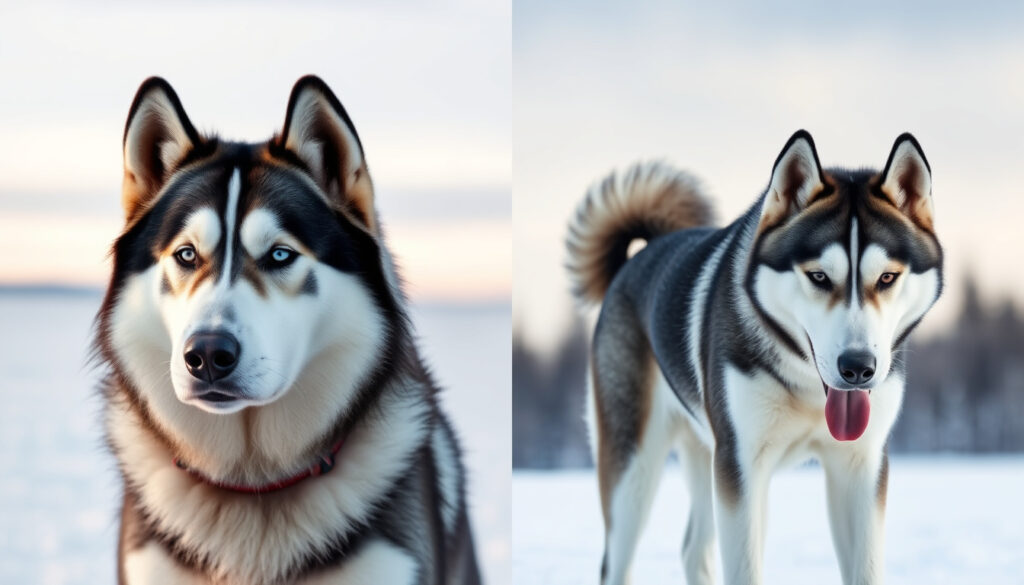
Alaskan Malamute vs Husky: Key Differences in Temperament and Size
An Alaskan Malamute and a Siberian Husky look like cousins but act like rivals in temperament and strength. For instance, the Kennel Club standard lists a preferred male Malamute at 85 pounds (The Kennel Club breed standard) — a full 25 pounds heavier than the typical Husky.
Weight range: 65–85 lbs (male), 50–70 lbs (female) · Height at shoulder: 24–26 inches (male), 22–24 inches (female) · Coat type: Thick double coat, dense undercoat (The Kennel Club) · Temperament: Affectionate, loyal, independent, alert (WebMD)
Quick snapshot
- Alaskan Malamute is a distinct breed from Siberian Husky (The Kennel Club) (United Kennel Club)
- Males weigh 65–85 lbs, females 50–70 lbs (United Kennel Club)
- Exact origin date of the breed is unknown
- Number of Malamutes worldwide is not precisely tracked
- Aggression risk percentages vary by study
- Good with children when socialized, though size requires supervision (ShowSight Magazine)
- Ancestors used by Inuit peoples (Mahlemuit tribe) (ShowSight Magazine)
- Continued popularity as family pets (WebMD)
| Attribute | Details | Source |
|---|---|---|
| Origin | Alaska, USA | The Kennel Club (breed standard) |
| AKC Group | Working | The Kennel Club (breed standard) |
| Lifespan | 10–14 years | WebMD |
| Coat | Thick double coat, various colors (gray, black, sable, red) | The Kennel Club (breed standard) |
| Temperament | Affectionate, loyal, intelligent, independent | The Kennel Club (breed standard) |
| Exercise Needs | High (60+ minutes daily) | WebMD |
| Suitability for Families | Good with training and socialization | ShowSight Magazine |
Are Alaskan Malamutes Good Pets?
Alaskan Malamutes are affectionate, loyal, and intelligent dogs that form strong bonds with their families (The Kennel Club (breed standard)). However, they require regular exercise and mental stimulation to stay happy.
- Daily walks, runs, or pulling activities are essential – this is a breed built for work.
- They can be independent and stubborn, which makes training a challenge for first-time owners.
- If socialized early, Malamutes are good with children, though their size and strength mean adult supervision is always needed.
The same independence that makes Malamutes less clingy than some breeds also means they can be willful during training. For owners who enjoy a dog with a mind of its own, that’s a plus – for those wanting eager-to-please obedience, consider a different breed.
The pattern: Malamutes reward experienced owners but can overwhelm first-timers without consistent training.
Malamute vs Husky: What’s the Difference?
Temperament and Trainability
- Malamutes are described by the Kennel Club as “affectionate, friendly, loyal, and devoted,” while Huskies are known for being “outgoing, friendly, and loving” with a strong independent streak (Pooch & Mutt).
- Independence Veterinary Clinic notes that Malamutes often display a stronger protective instinct, while Huskies are more playful and social (Independence Veterinary Clinic).
- Training a Malamute requires patience because of their stubbornness; Huskies may be even more challenging due to their high energy and distractibility.
Size and Strength Comparison
The size gap is where these breeds diverge most clearly. Here’s a side-by-side look at official breed standards:
| Attribute | Alaskan Malamute | Siberian Husky | Source |
|---|---|---|---|
| Male weight (ideal) | 85 lb (39 kg) | 45–60 lb | The Kennel Club |
| Female weight (ideal) | 75 lb (34 kg) | 35–50 lb | United Kennel Club |
| Male height at shoulder | 25 in (64 cm) | 21–23.5 in | The Kennel Club |
| Female height at shoulder | 23 in (58 cm) | 20–22 in | United Kennel Club |
| Body type | Substantial, deep chest, heavily muscled | Moderate, lighter frame | UKC |
| Bred for | Hauling heavy freight | Speed and endurance | ShowSight Magazine |
The pattern is clear: Malamutes are built for power, Huskies for agility. A Malamute can weigh nearly twice as much as a Husky, and that weight difference is all muscle.
Grooming and Shedding
- Both breeds have thick double coats, but the Malamute’s is denser and longer (The Kennel Club).
- Shedding is heavy year-round and becomes extreme during seasonal blows; brushing 2–3 times a week is a minimum.
- Malamutes require more grooming time because of their larger coat volume.
If you want a dog that can pull a sled or carry heavy packs, the Malamute is the obvious choice. For a lighter, more agile running partner, the Husky may be a better fit – but be prepared for a dog that needs even more exercise.
Is an Alaskan Malamute a Husky?
No – they are two distinct breeds. The American Kennel Club recognizes each as separate: the Alaskan Malamute in the Working Group (since 1935) and the Siberian Husky in the Working Group (since 1930). While both are Arctic sled dogs, their builds and purposes differ. Malamutes are larger, more powerful, and were bred for heavy freight, while Huskies were bred for speed and lighter loads (ShowSight Magazine). The confusion often comes from their similar appearance, but a Malamute’s bulk and the Husky’s more refined frame make them easy to tell apart once you know what to look for.
Are Alaskan Malamutes on the Aggressive Dog List?
Alaskan Malamutes are not typically listed on official aggressive dog lists used by insurers or municipalities. However, they can be dominant with other dogs, especially after maturity (The Kennel Club (breed standard)). The breed’s temperament is generally friendly toward people, but any large, powerful dog can cause harm if poorly trained or socialized. Breed-specific legislation (BSL) varies by location; some areas restrict “dangerous breeds” including Malamutes, but they are less commonly targeted than Pit Bull Terriers. In fact, the most frequently cited aggressive breed by bite data is the Pit Bull Terrier, not the Malamute.
What this means: aggression in Malamutes is rare but real when it occurs – typically rooted in poor socialization or lack of clear leadership. A well-trained Malamute is a gentle family dog, not a menace.
Which Is Stronger, Husky or Malamute?
The Alaskan Malamute is significantly stronger than the Siberian Husky. The Kennel Club standard describes the Malamute as a “powerfully built” dog, and its entire history is based on hauling heavy loads over long distances (The Kennel Club). In contrast, Huskies were bred for speed and endurance, not raw pulling power. A Malamute’s bite force is also estimated to be higher due to its larger jaw and head. If you need a dog that can pull a heavy cart or sled, the Malamute is the clear winner. For a running companion, the Husky’s lighter frame is an advantage.
Alaskan Malamute Size, Weight, and Puppy Considerations
Official breed standards provide the clearest picture of what to expect.
Male Malamutes stand 24–26 inches at the shoulder and weigh 65–85 lbs; females are 22–24 inches and 50–70 lbs (United Kennel Club). Puppies grow rapidly and need a diet formulated for large breeds to prevent joint problems.
What Is a Giant Alaskan Malamute?
A “giant” Malamute refers to individuals that exceed the breed standard, sometimes reaching over 100 lbs. These dogs are not within AKC or UKC standards and may be prone to health issues like hip dysplasia. Responsible breeders adhere to standard size limits to maintain health and working ability.
Alaskan Malamute Pronunciation
The breed is pronounced /ˈæl.æs.kən ˈmæl.əˌmjuːt/ – “AL-uh-skan MAL-uh-myoot.”
Pros of Alaskan Malamute
- Loyal and affectionate family dog (WebMD)
- Excellent working ability and strength
- Beautiful, thick coat (though sheds heavily)
- Good with children when socialized (ShowSight Magazine)
Cons of Alaskan Malamute
- High exercise needs – not for sedentary households
- Stubborn and independent, challenging to train (The Kennel Club)
- Heavy shedding requires constant grooming
- Can be dominant with other dogs (The Kennel Club)
The catch: Giant Malamutes may look impressive, but exceeding the standard size often brings higher health risks.
“The Alaskan Malamute is a powerfully built, substantial dog with a deep chest and strongly muscled body.”United Kennel Club (breed standard)
“Alaskan Malamutes are affectionate, loyal, and playful – they are confident dogs that need a confident owner.”WebMD veterinary contributor
For potential owners weighing the two breeds, the choice comes down to lifestyle. If you want a heavier, stronger dog for pulling or protection and can commit to regular exercise and grooming, the Malamute is a rewarding partner. If you prefer a lighter, more social dog that’s better with other dogs and easier to handle, the Husky might be a better fit. For the average family in a suburban home, neither breed is low-maintenance – but with the right preparation, a Malamute can be a wonderful, devoted addition to the household.
Related reading: Bar Stools Ireland: Clearance Sales & Local Retailers · How to Cook Bacon in the Oven: Easy Crispy Method
petpost.com.au, en.wikipedia.org, poochandmutt.co.uk, youtube.com, hillspet.com, airtasker.com
For a more in-depth look at the breed, check out this detailed Alaskan Malamute guide covering temperament, size, and key differences from the Husky.
Frequently asked questions
How much exercise does an Alaskan Malamute need?
Do Alaskan Malamutes bark a lot?
Can Alaskan Malamutes live in apartments?
Are Alaskan Malamutes good with other dogs?
How much do Alaskan Malamute puppies cost?
What health issues are common in Alaskan Malamutes?
Do Alaskan Malamutes shed heavily?
How to train an Alaskan Malamute?
More related posts
 Who Won the Debate Tonight? RTÉ Late Debate Results
 Alexandra Trusova Baby, 2026 Olympics No-Show, and Future
 مواقيت الصلاة في ميسيساغا – ISNA Prayer Times Today
 Bonnie Critchley: Military Veteran vs. Pierre Poilievre
 Paul Palleschi Recreation Centre: Amenities, Pool & Brampton Guide
 Sheikha Mahra: Biography, Husband, Divorce, Net Worth & More
 Susur Lee: His Restaurants, Family, and Career Journey
 How Much Is a Costco Membership? 2025 Fees and Perks