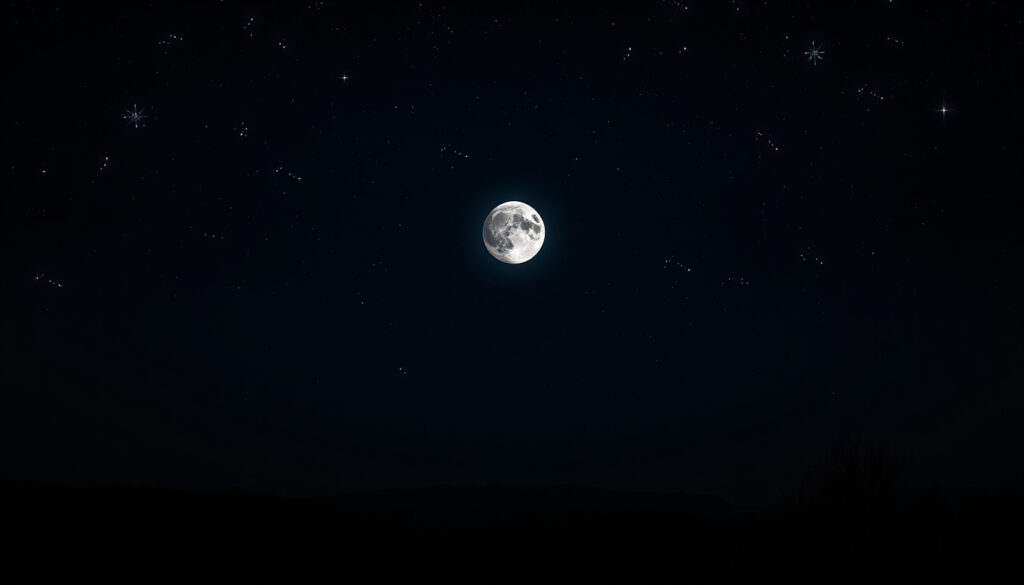
Pleine Lune Mars 2025 – Exact Date, Eclipse and Viewing Guide
The first major celestial event of spring 2025 arrived with the full Worm Moon on March 14, a night that paired traditional lunar naming with a rare astronomical spectacle. A total lunar eclipse transformed the Moon’s familiar glow into striking shades of copper and red, visible across vast stretches of the Western Hemisphere. For skywatchers in North and South America, this convergence of cultural tradition and cosmic geometry offered one of the year’s most accessible astronomical events.
Unlike some full moons that arrive during lunar perigee, this particular Full Moon occurred near apogee—the point in the Moon’s orbit farthest from Earth. The result was a slightly smaller appearance than average, earning the designation of micromoon rather than supermoon. Despite its diminished apparent size, the eclipse more than compensated, treating observers to a celestial show that unfolded over several hours. The event also marked the first total lunar eclipse visible from much of the United States in recent years, drawing both casual viewers and seasoned astrophotographers into backyards and observatories alike.
When Is the Full Moon in March 2025?
Astronomical calculations confirmed the full moon reached its peak illumination on March 14, 2025, at precisely 06:55 UTC. For observers in the eastern United States, this translated to 2:55 a.m. EDT on the same date. Full moons occur when the Moon positions itself exactly 180 degrees opposite the Sun, with its face fully illuminated by reflected sunlight. NASA’s official eclipse documentation provided the authoritative timing for this event, verified through multiple astronomical institutions.
March 14, 2025
06:55
Worm Moon
No (Micromoon)
Key Details for Viewing the March 2025 Full Moon
- The total lunar eclipse represented the first major lunar eclipse visible from most of the United States in years
- Eastern observers enjoyed the highest positioning of the Moon during totality, approximately 43 degrees above the southwestern horizon in New York City
- Western regions saw the eclipse begin or progress as the Moon rose above the horizon, creating dramatic landscape photography opportunities
- The Moon reached 100% illumination at peak, though eclipse shading altered its apparent brightness throughout the event
- France and Western Europe experienced the late stages of the eclipse before moonset, with the full moon occurring at 07:55 CET on March 14
- The event occurred during Saros cycle 123, a series of lunar eclipses that repeat approximately every 18 years
- Following the eclipse, an occultation of Spica (Alpha Virginis) became visible from certain regions on March 15 or 17 depending on location
| Fact | Details |
|---|---|
| Illumination at Peak | 100% of visible lunar surface |
| Moon Phase Cycle | Approximately 29.5 days between successive new moons |
| Orbital Position | Near apogee (farthest from Earth), resulting in smaller apparent size |
| Umbral Magnitude | 1.1804 at the descending node |
| Eclipse Type | Total lunar eclipse (Saros 123) |
| Visibility Region | Primarily the Americas; partial visibility in western Europe, Africa, and the Pacific |
| Apparent Diameter | Slightly below average due to apogee proximity |
What Is the Worm Moon and Its Significance?
The name “Worm Moon” traces its origins to Native American traditions, particularly those of Algonquin tribes who tracked seasonal changes through lunar cycles. As winter’s grip loosened and soil temperatures rose, earthworms began their resurgence through the thawing ground—a reliable biological indicator that warmer months approached. The emergence of these creatures signaled broader ecological awakening, marking the transition from dormancy to renewed growth.
Colonial settlers and European astronomers adopted many Native American lunar names, adapting them to their own calendars and agricultural needs. The Worm Moon thus entered broader astronomical literature as the traditional designation for March’s full moon. Contemporary astronomical publications continue to reference these names, preserving the cultural connection between celestial observation and terrestrial rhythms.
Cultural Connections to the March Full Moon
Beyond earthworms, March’s full moon coincided with maple sap flow across northeastern woodlands, a period when Indigenous communities harvested syrup and sugar from sugar maple trees. European settlers similarly recognized March as a turning point in the agricultural calendar, with lengthening days spurring preparations for spring planting. The Worm Moon therefore represented not merely a celestial phenomenon but a convergence of natural and cultural markers heralding seasonal transition.
The total lunar eclipse accompanying this Worm Moon represented only the second occasion in recent years when a major eclipse coincided with a traditionally named full moon. The combination heightened public interest, as viewers could observe both the astronomical event and appreciate the cultural heritage embedded in lunar nomenclature.
Is the March 2025 Full Moon a Supermoon?
Contrary to assumptions that all prominent full moons qualify as supermoons, the March 2025 Worm Moon occurred near lunar apogee—the orbital point farthest from Earth. This positioning produced a micromoon effect, with the lunar disk appearing approximately 7% smaller than average. The difference in apparent size proved subtle to casual observers but measurable through astronomical instruments.
Supermoons occur when a full moon coincides with perigee—the Moon’s closest approach to Earth—creating an illusion of increased brightness and size. The March 2025 event specifically excluded this condition, making the designation of supermoon technically inaccurate. Astronomical reference sources consistently clarified this distinction, preventing confusion among skywatchers who might have expected enhanced visual impact.
The Total Lunar Eclipse: A Rare Celestial Bonus
What the Worm Moon lacked in supermoon status, it compensated for through a spectacular total lunar eclipse. The eclipse unfolded through distinct phases: penumbral contact began at 03:57 UTC, followed by partial obscuration at 05:09 UTC. Totality itself spanned from 06:26 to 07:31 UTC, with maximum eclipse occurring near 06:58 UTC—just three minutes after the moon’s full illumination.
During totality, Earth’s shadow transformed the Moon’s familiar silver glow into rich shades of copper, orange, and deep red. This coloration resulted from Rayleigh scattering—the same atmospheric phenomenon that sunsets appear orange and red. Earth’s atmosphere bent longer wavelengths of sunlight into the shadow cone while absorbing shorter blue wavelengths, casting an atmospheric glow across the lunar surface.
The period of totality offered optimal conditions for lunar photography, as the Moon’s reduced brightness allowed for longer exposure times without overexposure. Astrophotographers could capture the eclipse’s copper hues with standard camera equipment mounted on tripods.
How and Where to View the March 2025 Full Moon?
Visibility conditions varied significantly across geographic regions, with the Americas enjoying the most comprehensive views of the eclipse. The Eastern United States and Canada experienced the full progression of the eclipse with the Moon positioned high enough above the horizon to permit clear observation. Western observers faced the challenge of timing their viewing to coincide with moonrise, though this obstacle created opportunities for striking landscape photography.
Viewing Conditions by Location
New York City residents witnessed the Moon rise at 6:36 p.m. EDT on March 13, well before sunset at 7:01 p.m. The partial phase commenced at 1:09 a.m. on March 14, with totality occurring between 2:25 and 3:31 a.m. Mid-eclipse positioned the Moon approximately 43 degrees above the southwestern horizon—ideal elevation for comfortable viewing without building obstruction. Moonset followed at 7:18 a.m., concluding the event during morning astronomical twilight.
San Francisco observers encountered a different timeline, with the penumbral phase beginning at 8:56 p.m. local time on March 13. Totality occurred between 10:26 and 11:32 p.m., allowing late-night viewing without the pre-dawn demands facing East Coast observers. The partial phase concluded at 12:48 a.m. on March 14. NASA’s official eclipse resources provided detailed local timing calculations for dozens of cities across the visibility zone.
| Location | Moonrise | Key Eclipse Events (Local Time) |
|---|---|---|
| Honolulu, Hawaii | March 13, 6:21 p.m. | Partial begins 7:09 p.m.; totality 8:26–9:31 p.m. |
| Montevideo, Uruguay | Varied | Penumbral 12:57 a.m. Mar 14; totality 3:26–4:31 a.m.; moonset 6:53 a.m. |
| Christchurch, New Zealand | March 14, 7:49 p.m. | Totality ends 8:31 p.m. at moonrise |
Best Locations for Eclipse Viewing
Dark-sky preserves and national parks offered optimal viewing conditions away from urban light pollution. The Eastern United States and Canada provided the highest lunar positioning during totality, minimizing atmospheric interference from low-horizon viewing. Western South American locations like Uruguay experienced totality shortly before moonset, creating dramatic photographic opportunities when the eclipsed Moon hung near the horizon.
Pacific islands benefited from earlier local timing, allowing evening observation without sleep disruption. High elevation vantage points—mountain ridges, elevated parks, or building rooftops—enhanced clarity by reducing atmospheric moisture and particulate interference. Avoiding direct street lighting and residential glare improved contrast, allowing subtler eclipse features to emerge.
Photography Techniques for the March 2025 Full Moon
Capturing the eclipse required different techniques depending on the desired outcome. During totality, extended exposures of several seconds became possible as the Moon dimmed to apparent magnitudes comparable to bright star clusters. Tripod-mounted cameras with telephoto lenses (200mm or greater) resolved lunar surface details, while wide-angle lenses incorporated landscape context. NASA’s eclipse photography guidelines recommended starting exposures at 1/125 second during partial phases and extending to multiple seconds during totality.
Binoculars and telescopes enhanced visual observation, revealing subtle color gradients during totality that observers often described as copper, rust, or blood-red depending on atmospheric conditions. Tracking the Moon’s path through Earth’s umbra documented its progression across the shadow, a technique particularly popular among amateur astronomers documenting eclipse sequences.
Observers in locations where moonrise coincided with eclipse phases faced the challenge of viewing the event through maximum atmospheric density. Planning vantage points with clear western horizons proved essential; coastal beaches, elevated plains, or hillside lookouts offered unobstructed views as the Moon climbed into the eclipse.
Timeline of March 2025 Lunar Phases
The full moon represented the midpoint of a complete lunar cycle that began with the new moon on March 1 and concluded with another new moon on March 29. Understanding this progression helped observers anticipate optimal viewing windows and recognize the Moon’s changing appearance throughout the month.
- — New Moon: The lunar cycle commenced with the Moon positioned between Earth and the Sun, rendering it invisible from our planet.
- — First Quarter: The Moon reached 90 degrees east of the Sun, presenting as a half-illuminated disk in the evening sky.
- — Full Moon Peak: The Worm Moon reached maximum illumination coinciding with total lunar eclipse.
- — Last Quarter: The Moon arrived at 90 degrees west of the Sun, again appearing as a half-illuminated disk in the pre-dawn sky.
- — New Moon: The lunar cycle concluded, with the Moon returning to conjunction with the Sun.
The interval between successive new moons—approximately 29.5 days—defined the lunar calendar that many cultures historically employed for agricultural and ceremonial scheduling. The How Many Weeks Left in 2025 resource tracked how this celestial rhythm intersected with human timekeeping throughout the year.
What Is Confirmed and What Remains Uncertain?
Astronomical institutions worldwide have verified the fundamental parameters of the March 2025 full moon with high confidence. The peak timing (06:55 UTC on March 14), the total lunar eclipse duration (approximately 65 minutes of totality), and the visibility zone (primarily the Americas) rest on established orbital mechanics and have been confirmed by multiple authoritative sources.
Established Information
- Exact date and UTC time of full moon peak
- Total lunar eclipse occurrence and duration
- Micromoon status (near apogee)
- Traditional Worm Moon nomenclature
- Regional visibility patterns
- Eclipse phase timings in UTC
- Post-eclipse Spica occultation
Aspects Requiring Local Verification
- Precise local rise/set times for specific addresses
- Atmospheric conditions on the night of March 13–14
- Individual observer visibility through local terrain
- Actual coloration intensity during totality
- Specific camera settings optimal for personal equipment
- Real-time viewing experiences from remote locations
The U.S. Naval Observatory’s lunar phase calculations provided the foundational data underlying all official eclipse predictions. These calculations, derived from centuries of astronomical observation and refinement, offer precision measured in seconds rather than minutes. Local variations—atmospheric conditions, horizon obstructions, and equipment differences—remain beyond the scope of centralized prediction and require individual verification.
Understanding the Worm Moon’s Cultural Context
The Worm Moon exemplifies how astronomical observation intersects with terrestrial experience. Before artificial lighting and weather forecasting, lunar cycles provided reliable frameworks for organizing agricultural activities, religious observances, and social gatherings. Indigenous communities across North America developed sophisticated calendrical systems that tracked not merely the Moon’s phases but ecological indicators—the emergence of specific plants, animal migration patterns, and temperature thresholds—that contextualized celestial events within lived experience.
European colonists encountered these systems and, in many cases, adopted or adapted them for their own purposes. The practice of naming each month’s full moon entered mainstream American culture through almanacs, newspapers, and agricultural publications. While some names reflected European agricultural traditions, many—including Worm Moon—derived from Indigenous knowledge systems, representing a cross-cultural exchange that continues to influence how contemporary observers engage with the night sky.
Understanding this heritage transforms a simple astronomical event into a meditation on human connection to natural cycles. The March full moon’s appearance prompted communities to gather, whether for eclipse-watching parties, photography expeditions, or solitary contemplation. Almanac traditions continue documenting these connections, bridging historical observation with modern interest in skywatching.
Expert Sources and Scientific References
The Worm Moon’s astronomical parameters derive from institutions with established track records in celestial mechanics and observation. NASA’s Goddard Space Flight Center provided comprehensive eclipse documentation, including phase timings, visibility maps, and photography recommendations. The space agency’s Solar System Exploration division maintains active databases documenting lunar positions, orbital elements, and eclipse geometries.
“Full moons occur when the Moon is directly opposite the Sun with respect to Earth, allowing sunlight to fully illuminate the lunar hemisphere facing our planet.”
— NASA Moon Phase documentation
The NASA Scientific Visualization Studio generated animations depicting the eclipse’s progression, allowing observers to verify expected viewing sequences. Wikipedia’s March 2025 lunar eclipse entry consolidated data from multiple authoritative sources, providing a central reference for verification. Space.com’s coverage translated technical astronomical data into accessible formats for general audiences, bridging scientific precision with public engagement.
Full Moon Calendar — What’s Next After March 2025?
The April full moon, traditionally called the Pink Moon, arrives on April 13, 2025, offering the next opportunity for lunar observation. Unlike March’s event, the Pink Moon occurs during a period without scheduled lunar eclipses, though several planets will present favorable viewing conditions during evening hours. Those interested in NHL Standings 2025-2026 may notice the hockey schedule occasionally intersecting with optimal full moon viewing nights.
Supermoon enthusiasts must wait until later in 2025, when lunar perigee coincides more closely with full moon phases. These events typically generate heightened public interest due to the Moon’s enhanced apparent brightness and size. The following year’s Worm Moon will occur on March 3, 2026, with its own distinct characteristics and visibility conditions unrelated to the 2025 event.
Frequently Asked Questions
When is the next full moon after March 2025?
The next full moon occurs on April 13, 2025, traditionally known as the Pink Moon. This full moon arrives without an accompanying eclipse event.
What causes a full moon?
Full moons occur when the Moon positions itself exactly 180 degrees opposite the Sun from Earth’s perspective, with its entire near-side illuminated by reflected sunlight.
What is the difference between a supermoon and a micromoon?
A supermoon coincides with lunar perigee (closest approach to Earth), appearing larger and brighter. A micromoon occurs near apogee (farthest from Earth), appearing smaller and dimmer than average.
How often do total lunar eclipses occur?
Total lunar eclipses occur approximately two to four times per year globally, though any given location may experience one only once every few years on average.
Why does the Moon turn red during a lunar eclipse?
Earth’s atmosphere scatters shorter blue wavelengths of sunlight while allowing longer red wavelengths to pass through and illuminate the Moon during totality, creating the characteristic copper-red coloration.
What is the full moon calendar for 2025?
Major 2025 full moons include: January (Wolf Moon, January 13), February (Snow Moon, February 12), March (Worm Moon, March 14), April (Pink Moon, April 13), May (Flower Moon, May 12), and continuing through December.
What is the best equipment for photographing a lunar eclipse?
A tripod-mounted camera with telephoto lens (200mm+), manual exposure controls, and a remote shutter release provides the foundation for quality eclipse photography. During totality, exposures of several seconds become possible.
Can the March 2025 eclipse be watched online?
Various astronomical organizations broadcast live streams of significant eclipses. Space.com and NASA typically provide real-time coverage accessible through their websites and social media channels.
More related posts
 Russian President Vladimir Putin: Bio, Career & Facts
 Carrie Preston: Biography, Husband, Health, and Current Projects
 Baker Mayfield: Career, Net Worth, Rule & Lawsuit
 State and Main Barrie: Menu, Reviews, Reservations Guide
 Razer Viper V3 Pro Review: Best Gaming Mouse for Esports
 Kevin Bacon: Biography, Net Worth, Movies, and Family
 Grand Sirenis Cayo Santa Maria – Reviews Amenities and Guide
 Sebastian Maniscalco: Biography, Net Worth, Wife & Comedy