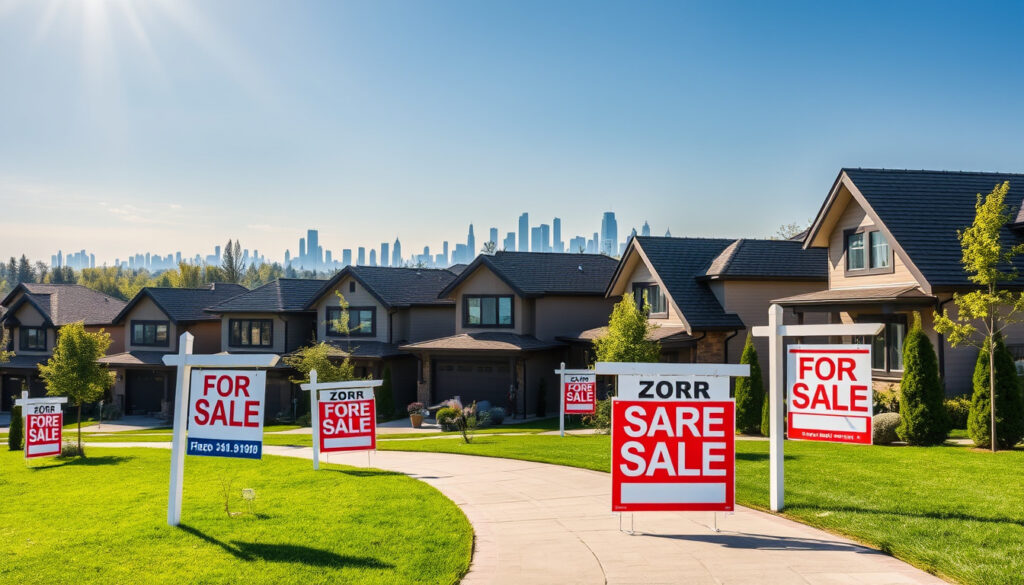
Mississauga Houses for Sale: Listings, Prices & Trends
Mississauga’s real estate market has shifted in a way that favors a specific type of buyer — and understanding exactly who benefits most could save you tens of thousands. First-time shoppers hunting entry-level condos and move-up buyers scoping out detached homes will find the numbers tell a clearer story than most local guides bother to explain.
Average House Price: $966,615 (March 2026) · Benchmark Price: $886,500 · Year-Over-Year Change: Down 6% from $1,067,451
Quick snapshot
- Average price $966,615 in March 2026 (WOWA.ca)
- Sales down 13.1% in 2025 to 4,710 transactions (REMAX Blog)
- Future price trajectory beyond March 2026
- Exact billionaire concentration data for specific neighborhoods
- Rents climbed 42% over seven years to 2024 (Bungalow Finder)
- Buyers’ market conditions expected to persist through 2026 (Bungalow Finder)
- Semi-detached homes expected to see strongest demand in 2026
- New construction pausing amid low buyer interest
| Metric | Value |
|---|---|
| Average Home Price (March 2026) | $966,615 |
| Benchmark Price (March 2026) | $886,500 |
| Median Price (March 2026) | $860,000 |
| Year-Over-Year Change | Down 6% from 2024 |
| 2025 Sales Transactions | 4,710 |
| First-Time Buyer Target | $800,000 townhome |
What is the average price of a house in Mississauga?
The data shows a clear downward arc. Mississauga’s average home price was CAD 1,068,304 in 2024, according to a Housing Needs Assessment compiled by Bungalow Finder. By 2025, that figure had cooled to $1,003,561 — a 6% pullback — and the most recent reading for March 2026 shows the average at $966,615, with a benchmark price of $886,500 and a median of $860,000, per WOWA.ca.
First-time buyers targeting townhomes around $800,000 are operating within a realistic window — something that wasn’t possible even two years ago when the average sat above $1 million.
Current benchmarks from MLS data
City Centre condos average around $560,000, with penthouses reaching up to $1 million, according to Phinney Real Estate. For those wondering whether the market favors buyers or sellers right now, Mississauga remains a buyers’ market in 2026 with increasing inventory and lower rates, per REMAX Blog market analysts.
Variations by neighborhood
The gap between neighborhoods is substantial. Port Credit averages $1.2M–$3M+ for detached homes, while Meadowvale ranges $650K–$950K, per RE/MAX Millennium. Lorne Park sits at the luxury extreme with $1.5M–$5M+, and Erin Mills lands in the middle at $900K–$1.5M for most property types.
The same $900,000 buys a modest detached home in Port Credit but a fully detached family home in Meadowvale — location determines whether you’re buying prestige or space. Mississauga homes for sale best neighbourhoods 2025 provides more detail on how each area stacks up.
Are Mississauga home prices rising or falling?
Mississauga home prices have been on a downward trajectory since their 2024 peak. The average slipped from $1,067,451 in 2024 to $1,003,561 in 2025 — a 6% year-over-year decrease — and sales volume cratered 13.1%, dropping from 5,417 transactions to 4,710, per REMAX Blog. The March 2026 reading of $966,615 suggests the decline is continuing, though at a slower pace.
Move-up buyers targeting detached homes in the $1,000,000–$1,500,000 range are finding more negotiating room than buyers did in 2022 or 2023, when bidding wars were common.
Recent 0.3% climb
While the broader trend has been downward, there are signs of stabilization. Some analysts reportedly point to a 0.3% monthly climb as of early 2026 — modest, but notable given the longer decline. The Hurontario LRT is expected to boost City Centre values over time, per Phinney Real Estate, and the Lakeview Village project is transforming the Lakeview area with new premium condos.
Market outlook
The market outlook hinges on inventory and interest rates. New construction is pausing due to low buyer interest, per REMAX Blog, which suggests builders are betting on a delayed recovery. Semi-detached homes are expected to see the strongest demand in 2026, potentially creating a tight segment even as overall inventory grows. Best Mississauga neighborhoods to live in real estate guide offers additional perspective on how buyer segments are shifting.
Is Mississauga a nice place to live?
Mississauga consistently ranks as one of Canada’s most livable mid-sized cities, with strong transit connections to Toronto, diverse neighborhoods, and a range of housing types from urban condos to suburban detached homes. The city scored well on amenities, green space, and community feel in multiple resident surveys cited by local real estate guides.
Lifestyle factors
Port Credit delivers waterfront living with restaurants and trails along Lake Ontario. Square One brings urban conveniences with one of Ontario’s largest shopping centers. Churchill Meadows is one of the newest neighborhoods in Mississauga, attracting young families with newer schools and parks, per Bungalow Finder. The Hurontario LRT, currently under development, will connect City Centre to key employment nodes across the city.
Pros and cons
Upsides
- Buyers’ market conditions — negotiating power swings to buyers
- Increasing inventory gives more options
- Condo entry point around $500,000–$650,000
- Strong transit connectivity to Toronto
- Mix of urban, suburban, and waterfront lifestyles
Downsides
- Rents climbed 42% over seven years to 2024 — affordability pressure for non-owners
- New construction pausing — fewer new-build options
- Luxury neighborhoods require $1.5M+
- Sales volume decline signals softer demand
What is the richest area in Mississauga?
Lorne Park stands out as Mississauga’s most affluent neighborhood, with average home prices ranging $1.5M–$5M+, per RE/MAX Millennium. The area is known for its tree-lined streets, estate-sized lots, and proximity to premium schools. Port Credit follows closely with detached homes averaging $1.2M–$2M+, offering waterfront prestige at a slightly lower price point.
Top luxury neighborhoods
The luxury segment breaks into distinct tiers. Lorne Park and Mineola average in the mid-to-high $2M range for detached homes, per Phinney Real Estate. Port Credit and Lakeview command $1.5M–$3M for premium detached product. Streetsville occupies a mid-luxury position at $1M–$2.5M, offering a village atmosphere without Lorne Park price tags.
Lorne Park details
Lorne Park combines estate-caliber homes with convenient access to the QEW and GO Transit, making it popular with executives and high-net-worth buyers who work in Toronto but prefer suburban privacy. The neighborhood’s restrictive character — limited new construction, mature lots — tends to support long-term value retention even in softer markets.
Entry at $1.5M+ means Lorne Park is essentially a different market from the rest of Mississauga.
Which is better, Brampton or Mississauga?
Comparing Mississauga and Brampton requires breaking down what “better” means for your specific situation. Mississauga offers higher average prices ($966,615 average versus Brampton’s lower median), better transit infrastructure including the Hurontario LRT, and established waterfront neighborhoods. Brampton historically offered lower entry prices but has seen rapid appreciation.
Key differences for buyers
For first-time buyers, Mississauga’s City Centre condos at $500,000–$650,000 provide a more affordable path to ownership than comparable Brampton properties, per Rakesh Babber, a real estate agent specializing in first-time buyer affordability. Mississauga’s top desirable neighborhoods for 2026 include Cooksville, Square One, and Port Credit, per REMAX Blog — areas with strong transit and amenities that Brampton struggles to match.
First-time buyer bets
For buyers under $700,000, Erin Mills townhomes starting around $700,000 and Meadowvale’s $650,000–$950K range offer the best combination of affordability and neighborhood quality within Mississauga, per Bungalow Finder. Meadowvale offers affordable entry with good rental yields compared to pricier areas, making it attractive for investors as well as owner-occupants.
Sheridan is one of Mississauga’s hidden treasures. It’s still more affordable than nearby luxury neighborhoods like Lorne Park, per RE/MAX Millennium — a smart consideration for buyers who want prestige proximity without prestige pricing.
Brampton may offer lower absolute prices, but Mississauga’s infrastructure and lifestyle amenities typically deliver better long-term resale value for comparable price points.
Mississauga Neighborhood Price Comparison
Three neighborhoods, three different markets: the pattern shows how geographic position and property type drive price more than square footage alone.
| Neighborhood | Price Range | Property Type |
|---|---|---|
| Lorne Park | $1.5M – $5M+ | Detached estates |
| Port Credit | $1.2M – $3M+ | Detached, waterfront |
| Sheridan | $800K – $1.4M | Mix, affordable |
| Meadowvale | $650K – $950K | Detached, townhome |
| Churchill Meadows | $850K – $1.2M | Newer family homes |
| City Centre | $500K – $650K | Condos (1-2BR) |
The pattern reveals how geographic position and property type drive price more than square footage alone.
“Mississauga may have a reputation for being expensive, but there are still pockets of affordability—if you know where to look.”
— Rakesh Babber, Real Estate Agent
“Mississauga will continue to be a buyers’ market. As inventory increases, many buyers are still sidelined.”
— REMAX Blog, Market Analyst
Related reading: Mississauga homes for sale best neighbourhoods 2025 · Best Mississauga neighborhoods to live in real estate guide
Frequently asked questions
How many houses are for sale in Mississauga?
Active listings across major portals exceed 2,000 homes, with approximately 807 houses available on Zolo.ca alone as of early 2026.
What neighborhoods have cheap houses for sale?
City Centre condos ($500K–$650K) and Meadowvale ($650K–$950K) offer the most affordable options. Sheridan and Erin Mills provide mid-range entry points with better space for families.
Are there Mississauga houses for sale with a pool?
Pool-equipped homes typically appear in higher-end neighborhoods like Port Credit, Lorne Park, and Lakeview — price ranges generally start at $1.2M and climb from there.
What is the cost of living in Mississauga?
Beyond housing, Mississauga residents face rising rents (up 42% over seven years to 2024), average condo maintenance fees around $500–$700/month, and property taxes that vary by neighborhood. A household earning $80,000–$100,000 annually can manage mid-market ownership with a co-signed mortgage.
Is $4,000 a month enough for Mississauga housing?
At $4,000/month gross income (approximately $48,000 annually), qualifying for a mortgage sufficient to purchase Mississauga’s median-priced home ($860,000) is challenging without a substantial down payment or co-borrower. Condo ownership in City Centre at $560,000 average is more achievable with a $100,000–$150,000 down payment.
Where can I find Mississauga houses under $700k?
City Centre 1-2 bedroom condos and Meadowvale townhomes fall within or near the $700,000 range. Listings appear on Zolo.ca, REALTOR.ca, and directly through RE/MAX and Royal LePage brokerages with Mississauga-specific filters.
More related posts
 Medicine Hat Houses for Sale: Prices, Neighborhoods & Tips
 Princess Auto Near Me – Locations, Hours and Store Guide
 Paul Palleschi Recreation Centre: Amenities, Pool & Brampton Guide
 Lil Uzi Vert: Pronouns, $24M Diamond, Hospitalization
 Who Invented the Telephone? The True Story Behind the Invention
 George Orwell: The Man Behind 1984 and Animal Farm
 Russell Brand: Verified Facts, Allegations & Charges 2025
 Sean Strickland: Net Worth, Suspension & UFC Record